Mgr. Martin Petráš
e-mail: martin[at]terapiepetras.cz
I graduated with a degree in Psychology from Masaryk University in Brno, and since then I have focused on my main professional interests: psychology, individual and couples psychotherapy, coaching, and career counselling.
For the past thirteen years, I have worked for EKS, a leading Czech organisation specialising in career counselling, where I serve as Deputy Director, coach, and personal development trainer. I have completed international placements in Newcastle, Dublin, and Ljubljana. I am a graduate of a five-year systemic psychotherapy training programme and hold a Swiss CH-Q certificate in competency mapping. In 2021, I passed the national professional qualification exam for career counsellors under the Czech National Register of Qualifications (NSK).
I am a co-founder of the successful Párovky project, where we work with couples in co-therapy, with two therapists working together. I have also collaborated with the Hedepy platform, where I ranked among its most popular online therapists based on client statistics. I have been running my own private practice for nearly ten years.
My Approach
One of the main advantages of the systemic approach is its versatility: it can be applied to a wide range of problems. Whether you simply need some advice or have been struggling with a serious issue for a long time, you are in the right place. This approach is built on partnership, trust, practical value, and modern scientific knowledge. It works with stories and your past, but also with the present and the near future. Its key principles include effectiveness, structure, and visible results.
As a person, I tend to be calm and thoughtful. I accept people as they are. I do not evaluate or judge you; what matters to me is how you perceive your own situation. I have no desire to change things you do not want to change yourself. It takes a lot to unsettle me. I see setbacks as something everyone experiences many times in life, and I will be there for you whether things go well or not. I value professional, high-quality work, and that is what you can expect from me. I believe therapy can be extremely helpful and sometimes even fun.
During our first meeting, we will discuss your expectations and, if appropriate, define a goal for our work together. Your progress towards meeting those expectations will then serve as our measure of success. Sessions vary from client to client. Some people prefer to explore issues in depth, while others favour a more practical approach focused on tangible results. We all have our own pace, and every approach is valid. At the end of each session, I will ask for your feedback and, if appropriate, we can arrange another appointment.
What Issues Do I Help With?
- Low self-esteem (I lack confidence, I am afraid of change, I find it difficult to make decisions)
- Anxiety, depression, panic attacks, and fears (I do not feel well, I feel afraid, my moods keep changing)
- Sexuality (I am exploring my sexual identity, I have a lower or higher sex drive, I struggle with pornography use)
- Relationship issues (different expectations within a couple, infidelity, communication difficulties, polyamory)
- Learning and education (I do not know which school or course to choose next, I struggle with studying, I am afraid of exams)
- Job searching (I am unhappy at work, I do not know what to do next, I need help preparing for an interview or writing my CV)
- Work performance (I am struggling to manage my workload, work stresses me out, I am experiencing burnout)
- Personal development (I want coaching as a form of mental self-care, I see working on myself as a way of life)
Reviews
- “Mr Petráš is a pleasant and kind therapist. I have only had one session with him so far, but I am planning to book more. He is a professional who makes it easy to open up about your problems. Highly recommended! 5 stars.”
- “Mr Petráš helped me overcome some difficult emotional states through his friendly and positive approach. He showed me how to get back on the path towards greater understanding and patience, not only with myself but also with others. Thanks to him, I have made significant progress in my personal development. I can wholeheartedly recommend his services to anyone.”
- “I have now had the opportunity to meet with Mr Petráš several times, and I always look forward to our sessions. He is always ready to offer support, advice, and a listening ear, or to help me assess a situation in whatever way I need most. He has been a great help to me, and it is a wonderful feeling to know that there is someone on the other side I can rely on.”
- “The conversation was exactly what I needed after a difficult day and a challenging period in my life. I am looking forward to the next session and would also appreciate some advice to help me in the days ahead. After therapy, you simply want to smile and feel a sense of relief :-)”
- “I was a little afraid of therapy. Opening up to a stranger does not come naturally to me. But with Martin, I have nothing to worry about. Our sessions are very relaxed and pleasant. Martin is sensitive, practical, and funny. My initial fear stemmed from previous experiences elsewhere, where my therapist seemed bored or completely exhausted. With Martin, I can feel that he genuinely enjoys getting to the heart of the matter, and that I am not bothering him by doing so.”
In the Media
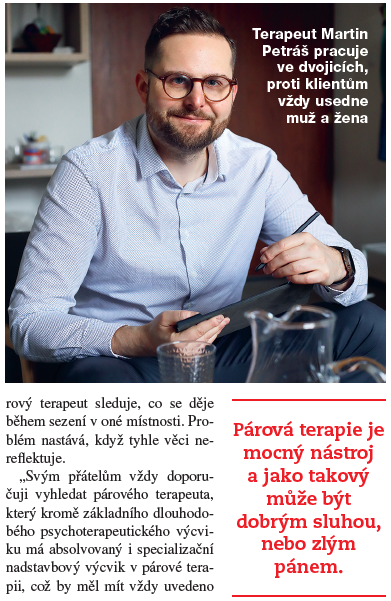
I was interviewed by Květy magazine (issue 15/2025) about couples therapy, which we offer as part of the Párovky project. Working together as a pair of therapists allows us to balance female and male perspectives and use techniques that would not be possible for a single therapist, such as sharing observations with each other during the session itself. I discuss how we are increasingly helping couples strengthen their relationships proactively, rebuild dialogue, and improve communication. I also welcome the growing awareness of psychotherapy as a tool for living a better, more fulfilling life.
For Statistika a My magazine (issue 04/2025), published by the Czech Statistical Office, I write about how, while the types of relationship problems remain largely the same (such as affairs and communication barriers), the way people articulate them and the broader social context are changing. There is a growing range of specific terms used to describe relationships. For example, the term “polyamorous” is now used for relationship arrangements that existed in the past without an explicit label. However, openness to discussing such arrangements in therapy is growing more slowly. At the same time, psychotherapy is increasingly seen as a normal way to support mental well-being. More and more often, we work with couples where one or both partners have already experienced individual therapy.